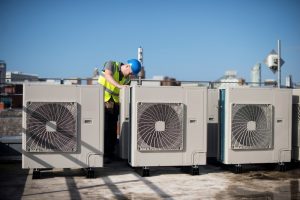
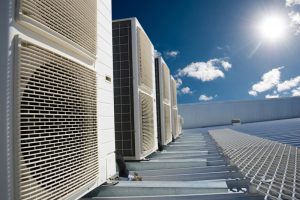
 Rooftop HVAC units are among the most frequently employed climate control systems for industrial and commercial facilities. The typical rooftop HVAC unit is a packaged system containing a compressor, expansion device, condenser coil, evaporator coil, and powerful blower fan. Unlike split systems, which place some of their components indoors (the air handler and one of the coils), a rooftop unit handles the heating and cooling in one unit and then sends the conditioned air down into the building’s ventilation system.
Rooftop units are advantageous for businesses because they remove all the bulky and noisy equipment out of the workspace and onto the roof. It’s easy for technicians to access them without disrupting workflow, and they’re modular to allow for a business to continue to expand. A well-installed rooftop unit can last for around 15 years.
However, any HVAC system can encounter repair issues. Below we’ve listed several common rooftop HVAC problems.
 If you’re currently looking to install commercial or industrial HVAC equipment for your facility, you’ll immediately encounter the question of how powerful the equipment needs to be and how many units you’ll need to have installed to meet the climate requirements of the facility. In the HVAC industry, the job of determining the heating/cooling output requirements for new installations is called
  Commercial air conditioning systems consume a great amount of energy. Compared to the standard residential AC systems, a commercial system costs 150% to 200% more to run on average, and that doesn’t account for how much
  This is a difficult question to answer in a standard blog because the type of business has a huge effect on control of temperatures and humidity. The range depends on whether the HVAC system is being used primarily to provide comfort to people inside the facility or if it’s designed to protect equipment and process. A large industrial space will need much different amounts of cooling during the summer than a small office space.
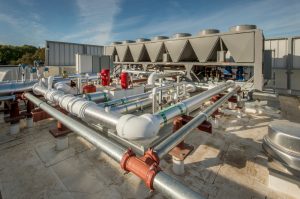 Providing air conditioning for a commercial or industrial facility is much different than air conditioning a residential home. Most houses use the same type of refrigerant-based split systems to provide cooling. There are some variations in design, such as ductless mini splits and packaged units, but they still operate on the exact same principles.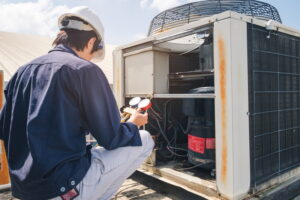
 The weather is still cold, but next week is the first week of spring, and spring means businesses need to start planning for the warmer weather and the changes it brings. For many facilities, that means ensuring that the cooling systems necessary to maintain proper temperature during the often hot and humid Toronto summers are working in peak condition and have the necessary adjustments, cleanings, inspections, and tune-ups to prepare them to handle the seasonal shift.
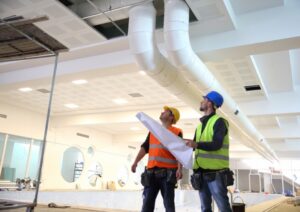 Commercial HVAC is a complex field that requires years of training and experience. Most business owners and commercial facility managers don’t have specialized knowledge of this field, and that’s the reason they rely on contractors like us for their commercial air conditioning and
  One of the most important commercial HVAC services we offer for our customers is cooling for a relatively small area of a facility. But it’s one of the most vital areas: the server room (also computer rooms and IT rooms).