
System of ventilating pipes
We recently discussed the problems of high humidity in buildings. In this post, we wish to talk more in depth about how we take a holistic approach to creating balancing humidity. A key part of this approach is managing humidity levels inside buildings through proper ventilation, air balancing, and dehumidification. As anyone who has gone through a single summer in Toronto knows, high humidity is a major problem—and it easily gets into buildings where it can cause significant damage beyond simply making a space less comfortable.
The standard measure of high humidity is relative humidity that’s greater than 60%. (Relative humidity is a measure of water vapor in the air relative to the temperature of the air, i.e. the percentage of water vapor in the air of the total amount that could be held at the current temperature.) Residential homes usually aim to balance humidity at 45%. But when it comes to commercial and industrial spaces the ideal humidity balance may be different based on equipment and process. This is one of the main reasons to work with professionals to combat humidity in your facility: our experts will know what humidity level is ideal for the space.
Continue Reading
Tags: Air Balancing, Dehumidifiers, Sheet Metal Installation, Toronto
Posted in Commercial Indoor Air Quality | Comments Off on Approaches to Humidity Balance
 This is a difficult question to answer in a standard blog because the type of business has a huge effect on control of temperatures and humidity. The range depends on whether the HVAC system is being used primarily to provide comfort to people inside the facility or if it’s designed to protect equipment and process. A large industrial space will need much different amounts of cooling during the summer than a small office space.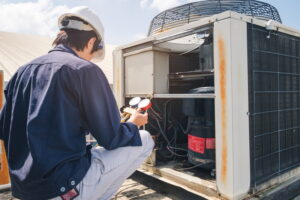
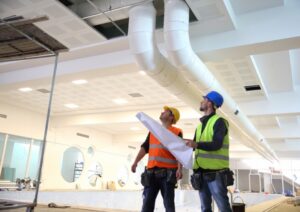 Commercial HVAC is a complex field that requires years of training and experience. Most business owners and commercial facility managers don’t have specialized knowledge of this field, and that’s the reason they rely on contractors like us for their commercial air conditioning and
  One of the most important commercial HVAC services we offer for our customers is cooling for a relatively small area of a facility. But it’s one of the most vital areas: the server room (also computer rooms and IT rooms).
  You don’t want your commercial facility to suffer from any interruptions during the harsh Toronto winters because of a heating system failure. This applies to almost any type of commercial operation, from manufacturing to retail.
  Although people connect the word “refrigerant” to devices that produce cooling, such as air conditioners and refrigeration equipment, refrigerant is often an essential part of the heating and cooling systems for commercial spaces. The standard rooftop units that most facilities use for climate control use refrigerant to both move into and out of the space. Under normal circumstances, refrigerant-based equipment will use the same charge of refrigerant through its service life—refrigerant circulates in a closed loop and does not dissipate through the heat exchange process.
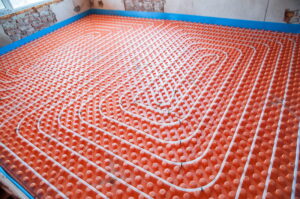 We work with all types of
 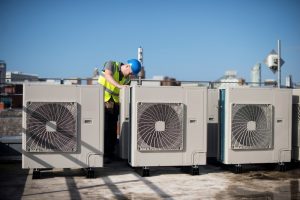 The task of providing cooling for a commercial facility is complicated. There are many more types of HVAC systems for commercial cooling than for residential. Residential homes favor the simple split system with an outdoor condenser and indoor evaporator with a blower and network of ducts. The wide range of types of businesses with their different needs requires a similar variety of commercial AC systems.
  Geothermal energy offers special advantages for heating and cooling commercial facilities. These systems remove boilers and cooling towers from the conventional HVAC set-up for a building and instead use the thermal energy of the earth—a renewable resource and one that allows for high levels of energy efficiency.